Hobby Whores: Exploring Mythology with Vixen Temple
 Dec, 8 2025
There’s a quiet revolution happening in the back rooms of forgotten libraries and the dim corners of occult bookstores. It’s not about magic spells or tarot readings-it’s about myth. Not the kind you read in school, but the raw, messy, living kind. The kind that still whispers in the wind off the Mississippi, that hides in the rustle of Spanish moss, and that wakes up screaming in the middle of a New Orleans summer night. This is where Vixen Temple lives. And she doesn’t just study mythology-she breathes it.
Some people call her a collector. Others say she’s obsessed. She calls herself a hobby whore. And if you’ve ever spent three days straight reading through Sumerian tablets while eating cold gumbo straight from the pot, you know exactly what that means. There’s a certain kind of person who doesn’t just like myths-they live inside them. And for Vixen, that means chasing stories from Babylon to the Yoruba forests, from Norse runestones to the drowned cities of the Amazon. She doesn’t collect artifacts. She collects voices. The kind that don’t stay buried. If you’re curious about how one woman turned myth into a full-time obsession, you might find yourself wondering what your own version of that looks like. Or maybe you’ve already met her-she’s the one who showed up to the Halloween party dressed as Ereshkigal, complete with a real obsidian dagger and a tattoo of the seven gates of the underworld. That’s not cosplay. That’s commitment. escort girl in paris might sound like a fantasy, but Vixen’s obsession is real, and it’s louder than any fantasy.
Mythology Isn’t History. It’s a Living Language.
Most people think mythology is old stories. That’s like saying poetry is just words on a page. Mythology is the first language of human emotion. It’s how people made sense of storms, death, love, betrayal, and power before science had answers. Vixen doesn’t treat these stories as relics. She treats them like code-broken, rewritten, passed down through generations, still running in the background of modern culture.
She’ll point out how the Greek tale of Persephone isn’t just about abduction-it’s about seasonal grief, about mothers losing children to adulthood. She’ll show you how the Aztec god Quetzalcoatl isn’t just a feathered serpent-he’s the embodiment of duality: life and death, wind and stone, knowledge and sacrifice. And she’ll make you feel it. Not with lectures. With silence. With a cup of tea. With the way she stares at the wall after telling you about the Babylonian goddess Ishtar descending into the underworld and being stripped of her clothes, her jewelry, her power, one piece at a time.
She says: "Myths aren’t about gods. They’re about what humans are afraid to say out loud."
Vixen Temple: A Woman Who Talks to Dead Gods
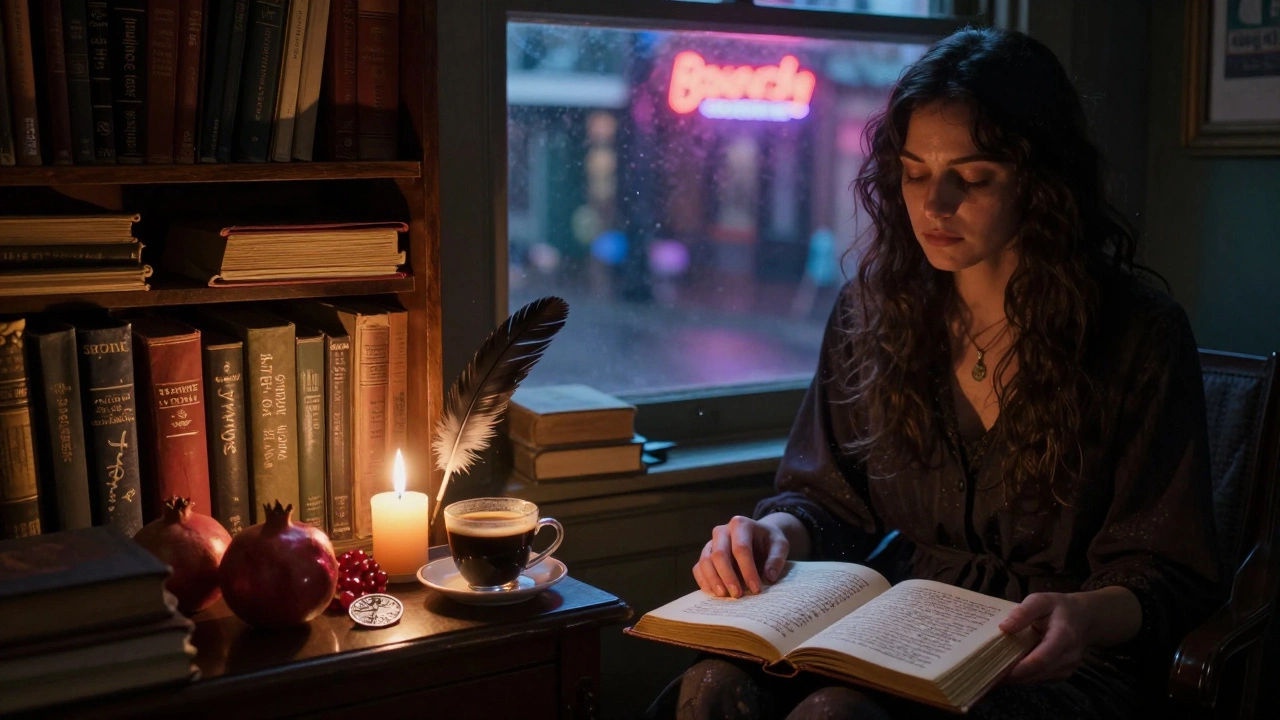
Her apartment in the French Quarter smells like dried sage, old paper, and something metallic-maybe copper, maybe blood. There are no TVs. No smartphones. Just shelves upon shelves of crumbling books, handwritten journals filled with translations in five languages, and a single altar where she leaves offerings: black coffee, pomegranates, a feather from a crow she found on the street, and a single silver coin from ancient Carthage.
She doesn’t pray. She listens.
She’ll tell you about the night she sat in the cemetery behind St. Louis No. 1 and whispered the name of the Egyptian god Anubis. She didn’t expect anything. But the wind changed. The air got heavy. And for the first time in her life, she felt like she wasn’t alone. Not because she heard a voice. But because she felt seen.
That’s when she stopped calling it a hobby.
She started calling it a dialogue.

Why Mythology? Why Now?
People ask her why she doesn’t just get a normal job. Why not become a professor? Why not write a book? She laughs. "I already have a job. I’m the keeper of forgotten truths."
She’s not trying to sell you something. She’s not trying to convert you. She’s just showing you that the old gods never left. They just changed their names. The war god became a sports team mascot. The fertility goddess became a perfume ad. The trickster became a meme.
And in a world where everything is fast, loud, and disposable, mythology is the slow burn. It’s the thing that stays when the trends die. That’s why she’s drawn to it. That’s why she spends her days translating cuneiform tablets on her laptop while her neighbors party on Bourbon Street.
She doesn’t need to be famous. She just needs to be heard.
How to Start Your Own Mythological Obsession
You don’t need a shrine. You don’t need to move to New Orleans. You don’t even need to believe in gods.
You just need to ask the right question.
Start with this: What story from your childhood still haunts you? Maybe it’s the one about the woman who turned into a tree. Or the one about the boy who lost his shadow. Or the one your grandma told you before bed-the one that made you check under the bed every night.
Write it down. Then find its origin. Google it. Go to the library. Ask a librarian. Don’t look for the "correct" version. Look for the strangest one. The one that doesn’t make sense. That’s the one that matters.
Then, sit with it. For a week. Don’t explain it. Don’t analyze it. Just let it live in your head. Sleep with it. Wake up with it. Let it change you.
That’s how Vixen started. With a story about a girl who drowned in a well and came back with black eyes.
She still dreams about that well.

The Dark Side of Obsession
Not everyone understands this kind of passion. Some call it madness. Others call it genius. Vixen doesn’t care what they call it. But she knows the cost.
She’s lost relationships. She’s missed birthdays. She’s been kicked out of apartments for keeping a skull on her nightstand. She’s been called a cultist, a witch, a fraud. Once, someone called her an "escort paris 2"-a strange, out-of-place insult that made her laugh so hard she cried. She didn’t know why they said it. But she kept the phrase. It stuck. Like a myth.
Her biggest fear isn’t being wrong. It’s being forgotten. That one day, someone will find her journals, her translations, her offerings, and think they’re just the ramblings of a lonely woman. She doesn’t want to be a footnote. She wants to be a whisper that echoes.
And maybe that’s the point of all mythologies-to be remembered, even if only by one person.
Myths Are Not Just Stories. They’re Mirrors.
When you study mythology long enough, you start seeing yourself in the gods. Not as a hero. Not as a victim. But as a force. A wild, messy, contradictory force.
Vixen doesn’t worship the gods. She recognizes them. She sees her own rage in Ares. Her loneliness in Hecate. Her stubbornness in Loki. Her hunger for truth in Orpheus.
That’s the power of myth. It doesn’t tell you who to be. It shows you who you already are.
She’ll tell you this: "The gods didn’t create humans. Humans created the gods to explain why they felt so alone. And now, we’ve forgotten we’re the ones still telling the stories."
So if you’re feeling lost, if you’re tired of the noise, if you’re tired of being told what to believe-go find your myth. Not the one everyone knows. The one that lives in your bones.
And when you find it? Don’t just read it. Talk to it. Leave it an offering. Wait. Listen.
It might answer.
It might not.
But you’ll know you’re alive.
And that’s more than most people ever get.
She’s been waiting for you to ask.
Now you have.
And that’s how myths begin.
One whisper. One question. One obsession at a time.
There’s a story about a woman who turned into a crow. She flew over the city every night, looking for someone who still remembered the old names. She never found them. But she kept flying. That’s the story Vixen tells when she’s tired. When she’s lonely. When she wonders if anyone else is still listening. She doesn’t need to be found. She just needs to keep flying. And so do you. escort black paris might be a fantasy, but the myth of being seen? That’s real.